The Best Insulated Rolling Steel Doors for Buffalo Warehouses
Insulated rolling steel doors are the workhorse closure for Buffalo warehouses, distribution centers, and manufacturing plants. A rolling steel door, sometimes called a service door, is a metal curtain made of interlocking slats that rolls up around a shaft above the opening. An insulated model uses thermally enhanced slats that reduce heat loss and limit condensation. In Western New York, the payoff is lower heating costs, safer dock operations, and fewer weather-related shutdowns during lake-effect events.
Decision-makers across Cheektowaga, Hamburg, West Seneca, Tonawanda, Amherst, and the Buffalo waterfront need doors that open and close on time, hold up to wind off Lake Erie, and keep conditioned air in. The right insulated rolling steel door also aligns with the dock leveler and vehicle restraint for a tight envelope that protects freight and workers. The wrong specification leads to slow operation, ice-bonded curtains at the sill, and avoidable repair calls in January.
Why insulated rolling steel matters more in Buffalo than in calmer climates
Buffalo sits on the east end of Lake Erie and absorbs long winter seasons with frequent freeze-thaw cycles. Lake-effect snow drives moisture into every gap and seam. The wind at Buffalo Niagara International Airport often averages near the low teens with storm gusts that push on large door openings. Those conditions create three predictable rolling door pain points on facilities from Larkinville to the Tonawanda industrial belt and along the I-90 NYS Thruway corridor.
First, heat loss at dock lines. A door that leaks air around the guide edges and at the sill becomes a continuous draft. Operators then run unit heaters longer, and product staged near the line sees condensation on cold days. Insulated slats with interlocking profiles and proper brush or rubber edge seals cut this load significantly.
Second, wind pressure on the curtain. A large opening exposed to the west faces cyclic wind loading. The curtain tries to billow, the barrel bearings work harder, and guides see uneven wear. A door with adequate wind load rating and deeper steel guides holds the emergency commercial door repair curtain in plane and avoids binding or blowout.
Third, ice bonding at the sill. Meltwater refreezes at the threshold. If a non-thermally broken bottom bar sits in ice, the curtain can freeze to the sill. Operators hit the button and the motor strains. That can shear a shear pin or trip the operator. Specifying a heated perimeter or a thermally efficient bottom bar with a deep neoprene astragal, which is the compressible bottom seal, reduces freeze-bond and improves first-cycle behavior on subzero mornings.
How insulated slats are built and why that build drives performance
Insulated rolling steel slats use a sandwich construction. Two steel skins form the exterior and interior faces. Between them sits an insulating core, often polyurethane foam or polystyrene. Polyurethane foam, which expands to fill the slat interior, typically delivers higher thermal resistance per inch and better panel rigidity. Polystyrene, which is a rigid board inserted into the slat cavity, can be cost-effective but may produce lower R-value. R-value is a measure of thermal resistance used to estimate how well a product resists heat flow.
Higher-density polyurethane cores add stiffness to the curtain. That stiffness helps in Buffalo’s wind. It also improves door quietness on busy dock lines in Amherst and Lancaster where dozens of cycles per hour are common during peak intake. Slat endlocks, which are small metal fittings that keep the slats aligned in the guides, should match the wind rating and cycle demand. Stainless or high-zinc coatings resist the salt-laden spray that creeps into docks in winter.
Thermal breaks at the bottom bar and high-quality side seals reduce conductive and convective losses. A thermally broken component separates metal-to-metal pathways that otherwise transfer heat rapidly to the outdoors. In practice, a solid insulated curtain with tight side seals and a well-sealed headbox can cut dock infiltration that otherwise defeats expensive weather seals on dock levelers.
Wind load, size, and cycle life in Western New York conditions
Most Buffalo warehouses run 8 to 10 foot wide dock doors and 10 to 12 foot high clear openings. Larger openings on drive-through bays and maintenance shops can reach 14 by 16 feet or more. As size grows, wind pressure and the mass of the curtain increase. The International Building Code (IBC) requires doors to meet wind load criteria by exposure category and design pressure. For sites near the waterfront, exposure can be severe. That makes guide depth, slat gauge, and windlock selection more than a checkbox. It is the difference between a curtain that stays seated in the guides during a 40 mph gust and a curtain that rattles and binds.
Cycle life defines how long the door can operate before springs, bearings, and operators need major service. Rolling steel torsion springs, which counterbalance the door’s weight, are rated in cycles. Heavy distribution in Cheektowaga near Walden Avenue or Transit Road might require high-cycle springs to avoid mid-season shutdowns. Operators can be chain hoist manual, which is a hand-pulled chain gear system, or motorized with in-line or jackshaft units. Variable speed operators with soft-start and soft-stop reduce shock loads on the curtain and hardware. That translates to quieter docks and fewer calls for commercial door repair during peak season.
Comparing insulated rolling steel to insulated sectional doors
Many Buffalo warehouses mix door types. Insulated sectional doors use hinged panels that slide up on tracks and rest under the roof deck. They can deliver excellent R-values and fast service on panel damage. They also need ceiling space and clear track paths that can interfere with lighting, sprinklers, and crane rails. Insulated rolling steel doors coil in a compact headbox and free up ceiling space for higher racking or equipment. They carry small footprints at the jambs, which is useful in tight docks where pallet racking sits near the opening.
Rolling steel also tolerates tougher environments. Steel slats shrug off incidental impacts better than thin aluminum. When a forklift bumps a rolling steel curtain at low speed, the slats may dent but the door often still operates. If a panel is heavily damaged, slats can be replaced in segments. For facilities that take regular wind and salt exposure, such as sites near the Niagara River or along Route 5, an insulated rolling steel specification with galvanized or stainless components pays back in durability.
Brands and hardware the Buffalo market depends on
Buffalo facilities frequently standardize on Cornell and Cookson for rolling steel service doors because of slat options, wind ratings, and parts availability. High-speed roll-up doors from Rytec and Albany serve interior zones and cooler doors where air exchange must be minimized. Sectional doors from Hormann are common on larger distribution projects, and A-24 Hour Door National Inc. Is an authorized service partner for Hormann commercial garage doors. That authorization matters when sourcing OEM, which means original equipment manufacturer, parts and warranty-aligned service on sectional lines operating beside rolling steel doors at the same docks.
On insulated rolling steel, look for factory packages that include insulated vision lites, which are small glazed windows set in the curtain, thermally broken bottom bars, and heated guide options for severe ice environments. Where a fire separation is required, a fire-rated rolling door must meet NFPA 80, which is the Standard for Fire Doors and Other Opening Protectives. Many facilities pair a non-fire insulated rolling door at the dock line with a separate fire-rated rolling door at interior fire walls to maintain energy performance and code compliance without overbuying at every opening.
Dock integration: levelers, seals, and restraints
A door does not live alone at the dock. It mates to a dock leveler, which is the ramp that bridges the truck bed to the building floor, a dock seal or shelter, which is the foam or fabric that seals around a trailer, and a vehicle restraint, which is the device that locks onto a trailer’s rear impact guard. For Buffalo sites along the I-190 and the 33 near KBUF, where throughput spikes during weather breaks, the system must move quickly and without rework.
An insulated rolling steel curtain that seals tightly against a dock seal reduces open-air exchange as trailers stage. That lowers infiltration while the dock door is still down and workers move to position the leveler. OSHA safety expectations for dock operations, which require clear, secure openings and visible control, favor motor operators with interlocks that prevent the leveler from cycling unless the door is up and the restraint is engaged. Those interlocks are not complex. They are simple switch circuits that tie the door operator to the dock controls. Done right, they cut errors and injuries.
What to prioritize when selecting insulated rolling steel doors for Western New York
Every property is different, but Buffalo puts the same pressure on all of them. The following selection points come directly from field experience across the 14204 Sycamore Street corridor, Downtown Buffalo 14202, the Medical Corridor 14203, and high-cycling suburban docks in 14225 Cheektowaga, 14228 Amherst, 14221 Williamsville, 14075 Hamburg, 14127 Orchard Park, and 14150 Tonawanda.
- Thermal performance: Choose polyurethane foam-filled slats for higher R-value and better rigidity. Confirm continuous side seals and a thermally broken bottom bar to reduce freeze-bonding. Wind load: Match design pressure to site exposure. Deep guides with windlocks keep the curtain engaged during gusts common off Lake Erie. Cycle rating and operator: Specify high-cycle springs and motor operators with soft-start and soft-stop for busy docks. Add interlocks with levelers and restraints for OSHA-aligned safety. Corrosion resistance: Use galvanized or stainless endlocks, fasteners, and bottom bars. Salt tracked into docks accelerates corrosion during winter. Serviceability: Confirm local parts support. Brands like Cornell and Cookson offer slat-by-slat replacement. Inventory access in Buffalo means faster repairs during peak season.
Cold weather operation details that separate good from great
Heated guides are optional devices that gently warm the steel channels the curtain slides through. They prevent ice buildup where condensation meets cold metal. On problem docks that face prevailing winds, heated guides eliminate bind and chatter that otherwise appears at 10 degrees Fahrenheit and below. A bottom weatherseal built from deep neoprene or EPDM, which is a durable synthetic rubber, compresses against uneven sills and resists salt. If the slab pitches toward the door and gathers meltwater, a trench drain in front of the opening can keep the sill dry and reduce freeze-bond.
Motor selection matters. Jackshaft operators mount to the head shaft and provide direct drive. In low temperatures, they run more reliably than chain-and-sprocket conversions exposed to moisture. A chain hoist manual is still useful as a backup. Train staff to pull evenly and check that the curtain breaks free before pulling hard. That simple habit avoids bent slats on mornings after deep freezes.
Safety, code, and standards to keep in view
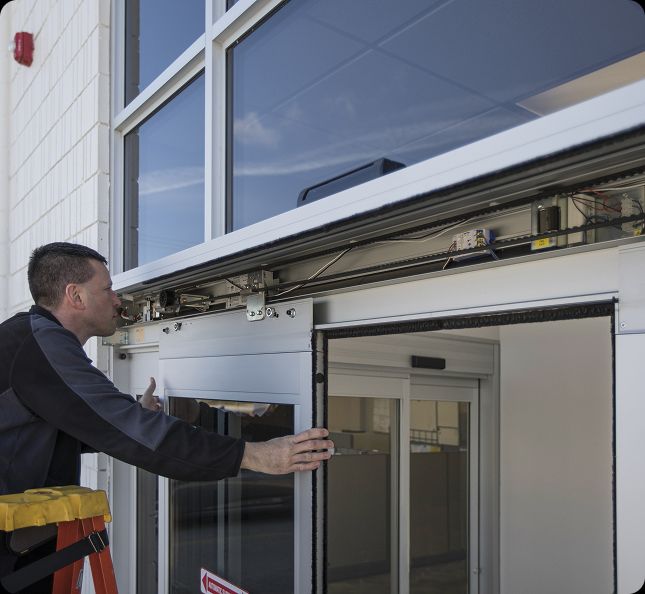
Where a door serves as part of a fire-rated separation, it must meet NFPA 80 and carry the proper label. Field modifications that drill or cut door components can void ratings. Keep fire doors distinct from insulated non-fire doors used for energy control at docks. Where automatic doors serve pedestrians in adjacent office or customer zones, AAADM, which is the American Association of Automatic Door Manufacturers, certification applies to sliding or swinging doors, and ANSI A156.10 and A156.19 govern those categories. While those standards do not apply to rolling steel, they often sit under the same facility maintenance program and affect training and inspection planning.
Means of egress for pedestrian routes are governed by IBC Chapter 10 and NFPA 101 Life Safety Code. Rolling steel doors at egress points need special arrangements and signage. Most warehouse rolling steel doors are not part of required egress, but any change in use can trigger review. When unsure, check with the City of Buffalo Department of Permit and Inspection Services or consult the facility’s design professional before altering openings.
Common Buffalo mistakes and how to avoid them
- Specifying light-gauge slats without windlocks on doorways facing the lake. Result: guide blowout during gusts and repeated service calls. Skipping thermal breaks at the bottom bar. Result: freeze-bond at the sill and operator overload on cold mornings. Unsealed headboxes. Result: warm interior air rises into the head, condenses on cold metal, drips, and ices the guides. Mixing fire and non-fire functions. Result: unnecessary cost or noncompliance if the wrong door ends up in a rated wall. Buying a brand with poor parts access in Buffalo. Result: multi-day downtime waiting for slats and endlocks during peak shipping weeks.
The Buffalo-specific, shareable takeaway
On Western New York docks, lake-effect storms often pair sub-20 degree Fahrenheit air with high humidity. That combination creates frost in door guides and along the sill even when precipitation is light. Facilities that install insulated rolling steel doors with heated guides and thermally broken bottom bars report fewer first-cycle stalls and faster morning startups. In busy corridors like business entry door repair Walden Avenue and Niagara Falls Boulevard, that difference can translate to hours of regained throughput during a storm week. It is a simple calibration to local climate that out-of-town specifications often miss.
Where insulated rolling steel fits with high-speed doors and sectional doors
Many Buffalo warehouses stack technologies to control air and manage traffic. A high-speed fabric roll-up door from Rytec or Albany often sits just inside an insulated rolling steel exterior door. The high-speed unit handles frequent cycling during active shifts. The insulated rolling steel door closes after hours and during cold snaps to hold temperature and improve security. Sectional doors from Hormann fill positions where interior headroom permits, or where glass vision is needed for safety on cross-traffic aisles. The mix is deliberate and based on door count, cycle rate, and exposure. The goal is fewer service interruptions and lower utility spend, not a one-size-fits-all door across the building.
Installation quality and service planning
A strong product underperforms if installation is rushed or misaligned. Guide plumb matters. Even a small twist across the opening causes the curtain to scrape and wear. Anchor selection for masonry or steel jambs affects long-term stability. At docks with uneven slabs, a small shim plan at the sill saves hours of callbacks later. Motor operator limit settings need patience so the bottom bar sets firmly against the sill without crushing the astragal. That line between tight and over-compressed is where energy performance lives and where strain on the operator is minimized.
Service planning should match Buffalo’s calendar. Late summer or early fall is the best window to perform a preventive check on rolling steel doors. The goal is to get ahead of freeze-bond behavior, confirm seals, lubricate bearings, and verify operator heaters if equipped. Winter emergency calls are more expensive and risk loading dock shutdowns during revenue-critical periods. Properties along Main Street Amherst, Transit Road, and the Seneca-Babcock corridor see high cycle counts. Quarterly checks on the most active doors and semi-annual checks on the rest fit the pattern that A-24 Hour Door National Inc. Sees across Western New York portfolios.
Cost ranges in context and why exact quotes require a site visit
Market pricing for insulated rolling steel doors spans a wide range based on opening size, wind rating, operator type, and options like heated guides or specialty finishes. Installed projects can land in the mid four figures for smaller, manual-operated doors at standard wind ratings and rise into the low five figures for large, motorized, wind-rated packages with controls integration. Exact pricing requires a site visit because headroom, wall construction, electrical availability, dock equipment integration, and exposure conditions around Buffalo and Erie County drive scope. Facility managers should also budget for long-life consumables such as bottom seals and side brush seals, which are minor compared to full curtain or operator work and help maintain thermal performance.
How A-24 Hour Door National Inc. Approaches insulated rolling steel doors in Buffalo
A-24 Hour Door National Inc. Works across Buffalo, Cheektowaga, West Seneca, Hamburg, Orchard Park, East Aurora, Lackawanna, Kenmore, Tonawanda, North Tonawanda, Amherst, Williamsville, Clarence, and Lancaster. The team evaluates openings for exposure, wind load, and traffic, then matches insulated slats, guide depth, and operator type to the actual dock workflow. Where high cycle counts demand it, high-cycle spring packages and variable-speed operators are specified. Where salt and spray are present, galvanized or stainless hardware is selected to slow corrosion. For mixed fleets, integration with dock levelers, restraints, and building management controls is handled so dock staff can run the line without second-guessing safety interlocks.
On mixed sites where storefronts, automatic entrances, or interior glass doors sit next to warehouses, the same service team can cover automatic sliding door repair and other business door repair tasks. That consolidation streamlines vendor management for multi-site portfolios spread across Western New York.
Repair considerations and stocked-truck realities during Buffalo winters
Rolling steel doors fail in a few predictable ways. Endlocks loosen, causing the curtain to skew. Guides develop ice ridges and bind. Bottom seals harden and stop sealing. Operators with weak capacitors fail to start under cold load. A-24 Hour Door National Inc. Runs stocked service trucks that carry common endlocks, bottom seals, bearings, limit switches, and operator components for Cornell and Cookson lines. That means many winter failures can be resolved in a single visit rather than a diagnose-then-return workflow that drags out downtime. For facilities that also run sectional doors, the team’s authorized service on Hormann commercial garage doors shortens parts lead times and protects manufacturer warranties.
Preventive maintenance aligns to the Buffalo pattern. The lake-effect cycle punishes seals and fasteners. Service contracts that include fall pre-winter checks catch small items before temperatures drop below 20 degrees Fahrenheit and everything stiffens. That is the threshold where hydraulic fluids in other door types thicken and where metal components on rolling doors start to change sound and behavior. Small adjustments made in September and October spare crews from fighting doors in January.
Local proof points facility managers can use
Property teams in 14222 Allentown and Elmwood Village report that wind hitting west-facing docks forces doors to pull away at the guide edges unless windlocks are used. Sites near the Waterfront and Cobblestone District take spray and salt that corrode unprotected bottom bars in a single season. Facilities near Highmark Stadium in 14127 Orchard Park see higher gust-related cycling on game weekends and need deeper guides to avoid chatter. These are not exotic conditions. They are normal Buffalo realities that should inform every insulated rolling steel door specification in the region.
Closing the loop on installation, service, and replacement decisions
Insulated rolling steel doors will serve Buffalo warehouses for decades if specified and installed correctly. Replacement should be considered when slat damage propagates across large sections of the curtain, when guides have elongated anchors in crumbling masonry that no longer holds plumb, or when operators require repeated major component replacements in a short span. Otherwise, a cycle of seals, endlocks, and operator service keeps doors reliable. On campuses with storefronts and automatic entrances in addition to docks, pairing rolling steel service with broader commercial door installation planning reduces total spend and standardizes training for building staff.
Why Buffalo businesses call A-24 Hour Door National Inc. For insulated rolling steel doors
A-24 Hour Door National Inc. Is a Buffalo-based commercial door contractor operating from 344 Sycamore Street, Buffalo NY 14204. The company covers Western New York 24 hours a day with direct-dispatch technicians and stocked service trucks. The team brings more than 30 years of commercial door service experience across warehouses, logistics hubs, retail, restaurants, office parks, and medical campuses. Authorized service on Hormann commercial garage doors supports sites that mix sectional and rolling steel doors. Rolling steel service aligns with Cornell and Cookson product families commonly installed across Erie County and Niagara County. For properties that also operate automatic entrances, AAADM-certified technicians handle automatic sliding and swinging doors under ANSI A156.10 and A156.19, with authorized service on Record brand entrance solutions. OEM parts with manufacturer warranties, a satisfaction guarantee, same-day emergency coverage, and flexible payment options including Cash, Check, Mastercard, Visa, American Express, and Net 30 for qualified customers support facility demands across 14202 Downtown, 14203 Medical Corridor, 14206 Broadway-Fillmore, 14213 West Side, 14215 University District, 14225 Cheektowaga, 14228 Amherst, 14075 Hamburg, 14127 Orchard Park, and beyond.
To evaluate insulated rolling steel doors for a Buffalo warehouse or to schedule commercial door repair on existing roll-up, sectional, or high-speed units, contact A-24 Hour Door National Inc. At (716) 894-2000 or the national line at (800) 884-4440. The dispatch center can coordinate site walks, urgent calls, or preventive maintenance planning. Online service information is available at https://a24hour.biz/buffalo/. Google Business Profile signals show strong local performance with a high rating and dozens of reviews. The team is fully insured and supports multi-site property portfolios across Western New York.